MH-8965Retail Media & Commerce
Square Launches First Standalone Kiosk With AI Ordering Assistant
Square has launched its first standalone restaurant kiosk, a 21.5-inch touch screen with a built-in AI assistant trained on each restaurant's own menu, items and pairings.
Wire notes
- Square launched Square Kiosk, its first dedicated standalone kiosk hardware for restaurants.
- The device features a 21.5-inch touch display with a built-in AI ordering assistant guests can talk to.
- Each screen is trained on the specific restaurant's menu, including popular items and item pairings.
- The assistant answers questions such as 'What are your vegetarian options?' and items under $10.
- Square disclosed no pricing, launch date, or accuracy data in the announcement.
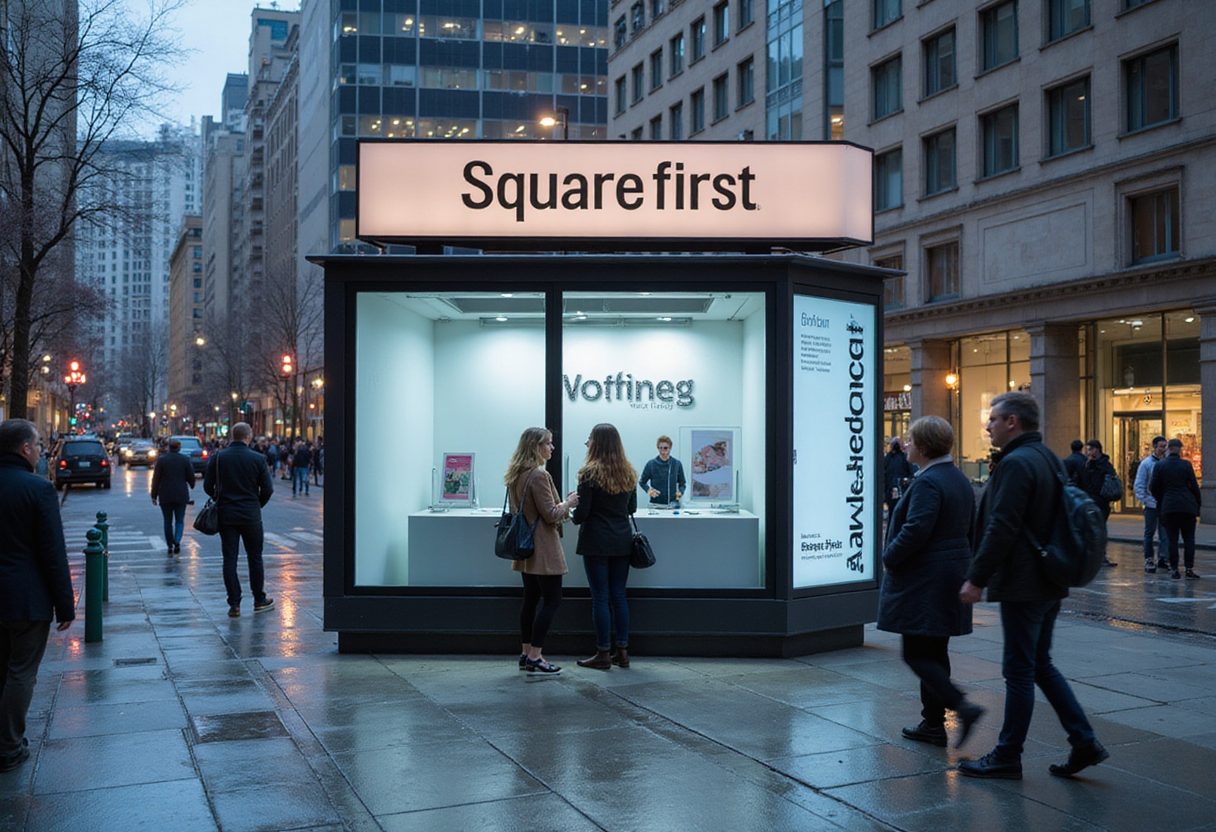
Square has launched its first dedicated kiosk hardware, a 21.5-inch touch display with a built-in AI ordering assistant that restaurant guests can talk to while placing orders.
The device, called Square Kiosk, marks the payments and ordering company's first standalone kiosk built specifically for restaurants. Square is one of the most widely used ordering-system providers for both small businesses and restaurant chains, which makes its hardware decisions a signal for the broader food-service technology market.
The AI assistant handles natural-language questions from customers. Square cites examples such as "What are your vegetarian options?" and "Can you show me everything that's under $10?" The system answers using each restaurant's own data, not a generic model. According to Square, every screen is trained on the specific restaurant's menu, including its popular items and which items pair well together.
What does conversational ordering change?
Kiosks have typically required customers to drill through menu categories on a touch screen. Square's approach replaces that navigation with dialogue: the guest asks, the kiosk answers and builds the order. The company frames this as removing friction between the customer and the menu.
James Schonzeit, head of food and beverage at Square, told ADWEEK: "Now, when you walk up to order from a kiosk, you can actually order in a way that feels really natural and also represents, hopefully, the best of the restaurant as well."
The quote carries a hedge worth noting. "Hopefully" is doing real work in that sentence — Square is promising a better representation of each restaurant, but the claim rests on how well the per-menu training performs in practice, something the announcement does not quantify. The company has not published figures on order accuracy, speed, or average ticket lift.
What Square is not saying
The announcement describes the product but stops short of several details buyers would need:
- No pricing for the Square Kiosk hardware or software was disclosed.
- No launch date beyond the reveal was specified.
- No restaurant partners, pilot results, or deployment counts were named.
- No data was offered on how the AI assistant handles ambiguous requests, substitutions, or allergen questions — a category where errors carry real risk.
That gap matters for operators comparing the device against established kiosk vendors, which typically publish integration timelines and case studies at launch.
Why per-menu training matters
The technical claim at the center of the launch is specificity. A kiosk trained on one restaurant's menu, its popular items and its item pairings can, in principle, upsell more effectively than a generic interface — suggesting the side that regulars actually order, not a random add-on. If the training works, it turns the kiosk from a cost-saving labor device into a revenue tool.
If it does not work consistently, restaurants inherit a new category of support problem: a voice-driven kiosk that answers incorrectly in front of the customer. Square has not said how restaurants correct or retrain the assistant when the menu changes, an everyday event in food service.
The takeaway
Square has moved the kiosk from a menu browser to a conversational salesperson; whether restaurants trust it enough to buy depends on details — price, accuracy data, and launch timing — that Square has yet to release.
By Amara Osei, Marketing Herald
via Adweek (Source)
More from Amara Osei
Show full bio
News editor covering people, launches and day-to-day practice in marketing, advertising, marketing technology, media, SEO and search at Marketing Herald.
125 articles